Last Updated on July 30, 2020 by Editor G
Dalmatia is a very distinct, historical region of southern Croatia. It comprises the central coastline of the country, hundreds of islands and several mountains.
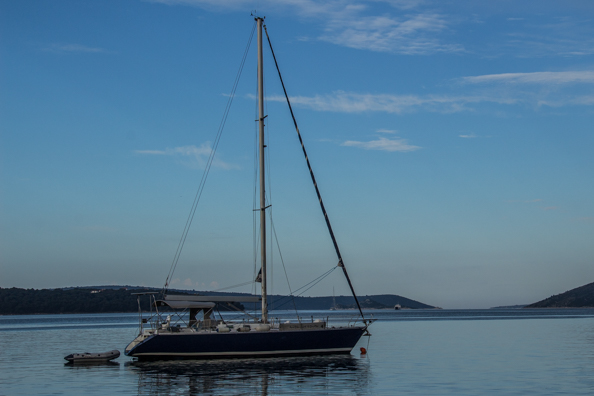
The Town of Split in Dalmatia
Split is the capital of Dalmatia and the second largest city in Croatia. A short stroll along its wide promenade, Riva, brought me to the entrance of Diocletian’s Palace. Diocletian was a Roman Emperor who built the palace as a residence for himself in 295 AD. After Diocletian died the palace was used as a retreat by the Roman rulers until the end of the sixth century when it was abandoned. Today what remains of the palace has merged with the old town of Split.
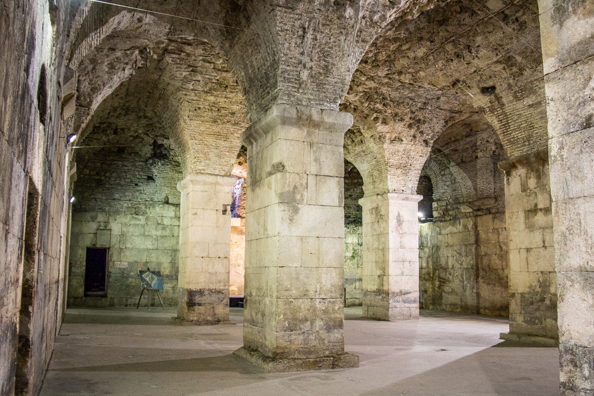
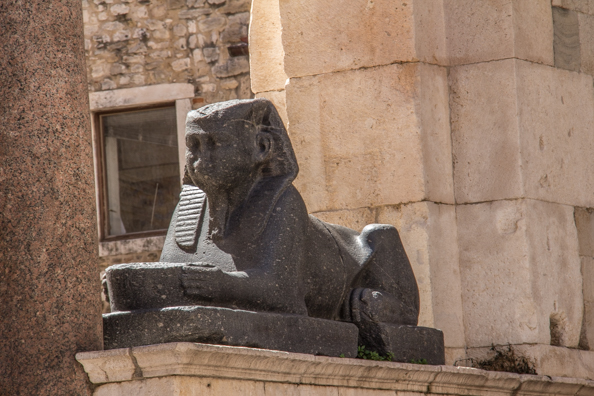
I entered the palace through the south entrance (fee payable) and walked through the large empty rooms to the centre of the old town, the peristil. This was the main open space in the palace and originally a temple. I entered the square through the archway in the middle of the fourteenth century Pjaca (town hall) that now houses the archaeological museum. The Cathedral of St Domnius stretches along the eastern side of square. The building was originally constructed as a mausoleum for Diocletian but was later turned into a cathedral to house the bones of the Bishop Domnius. The colonnaded square has steps on both sides. An unusual monument, an Egyptian sphinx keeps an eye on the steady stream of visitors. Diocletian brought twelve sphinxes back to Split after quelling a rebellion somewhere in Egypt. This is the only one that has survived.
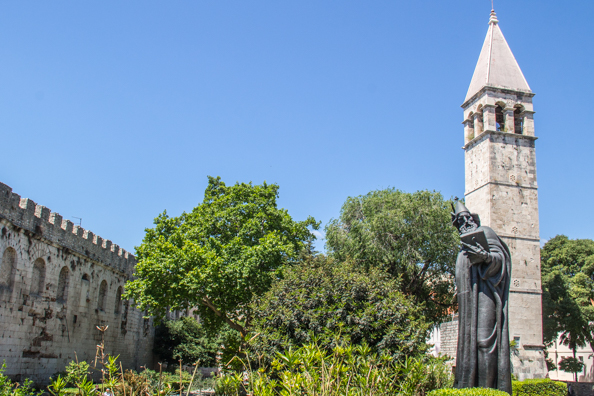
Dalmatia is famous for its traditional multi-part singing known as klapa which is now UNESCO protected As I roamed the narrow streets of the old town I could hear snatches of performances by a group of singers. The haunting melodies floated around me until I left the old town through the golden gate. Towering over this gate is the huge statue of Bishop Gregory of Nin (Grgur Ninski) Gregory promoted the idea that the Catholic church should hold mass in the local language rather than Latin and this prompted the notion that he was a protector of the Croatian identity. It is a very impressive monument created by the Croatian sculptor Ivan Mestrovic.
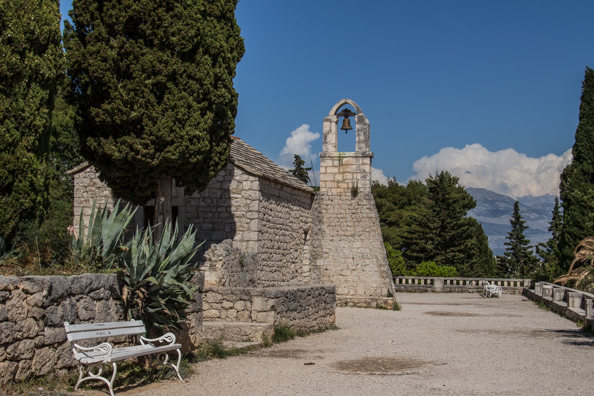
I returned to Riva for lunch at the restaurant of the Hotel Adriana overlooking the sea. My fried fresh squid with a glass of cold white wine was perfect. After my short break I was ready to climb the Marjan Hill that rises above the town. There are several paths through the Marjan Park a large wooded area on the slopes of the hill, that lead to the summit. I chose the shorter, steeper route that involved several flights of steps. From the terrace at the top the town and harbour was spread out below me and a welcome, cook breeze tugged playfully at my hair. It was a welcome break from the heat of the city. The park is famous for the large number of churches found there because the wooded area is considered to be a spiritual place. I only found one of them. The the Church of Saint Nicholas the Traveller. This thirteenth century church was built by a citizen of Split. All to soon it was time to leave and I strolled back along Riva – a delightful mixture of architecture from different eras including the elegant Prokurative or Republic Square. I was ready for a coffee and could have chosen the Venetian ambience of this square. Instead the old-fashioned cafe of the Bellevue Hotel close by. This was not just because the coffee was a lot cheaper but the old-fashioned interior was much more interesting.
The Town of Trogir in Dalmatia
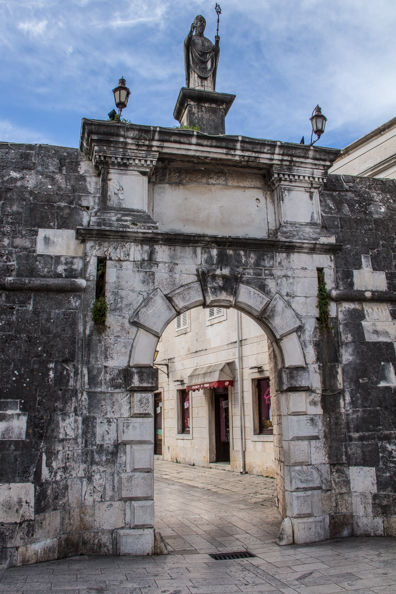
Trogir is close to Split and offers a completely different experience. The old town occupies an island. It is still surrounded by its city walls. After crossing the bridge that spans a narrow strip of water between the mainland and the island I entered the town through the North Gate. This gate was the main entrance to the town when it was ruled by the Venetians during the fifteenth century. When the gate was re-built during the seventeenth century it also featured a drawbridge. This no longer exists today. However, visitors can still enjoy some notable features of this Renaissance gate. They include the Lion of Saint Mark which symbolises Venice and a statue of Saint John of Trogir (Sv Ivan Trogirski
I made my way to the main square of the town, Trg Ivana Pavla II or Saint Paul II Square. This square was the original Roman forum. When the city was renovated during the fifteenth century its shape was changed. Today, most of the buildings that surround it were built during the nineteenth century. This square is dominated by the Cathedral of Saint Lawrence. It did not take me long to establish that I could climb to the top of its fourteenth century bell tower. It did not take me long to clamber up several flights of haphazardly positioned flights of stairs. The last flight narrowed into a three stone steps with a hole at the top that led into the belfry. I squeezed through the hole pleased, but not surprised, to find I was the only person up there.
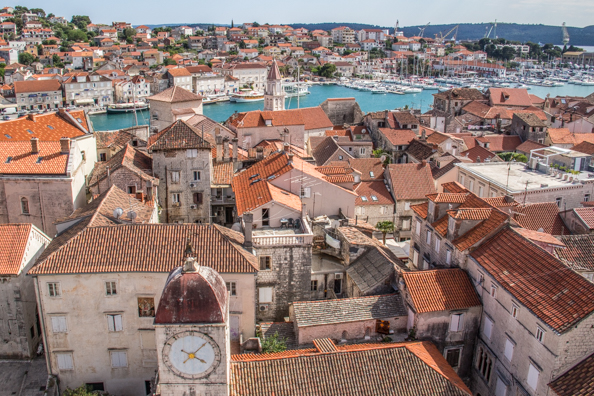
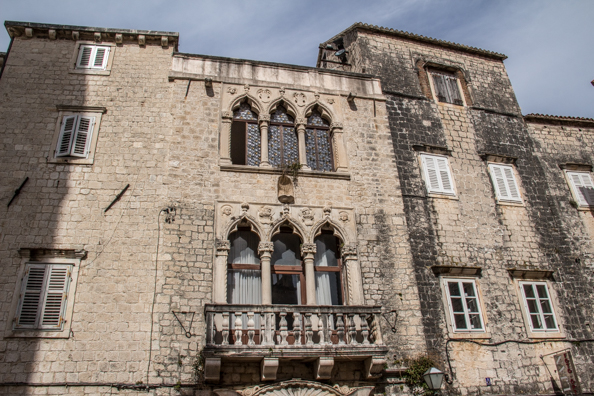
From my elevated position I had a great view of the façade of the grandiose, Large Cipiko Palace opposite the cathedral. This and several other palaces were built by the town’s most powerful families during the fifteenth century when the Venetians ruled. The famous architects Niccolò Fiorentino and Andrea Alessi created this building by joining two palaces together. It belonged to the Cipiko family and features a carved Venetian Gothic window and a carved wooden statue of a cockerel taken from the prow of a Turkish ship during a battle at sea. As the palace is in private ownership it is not open to the public.
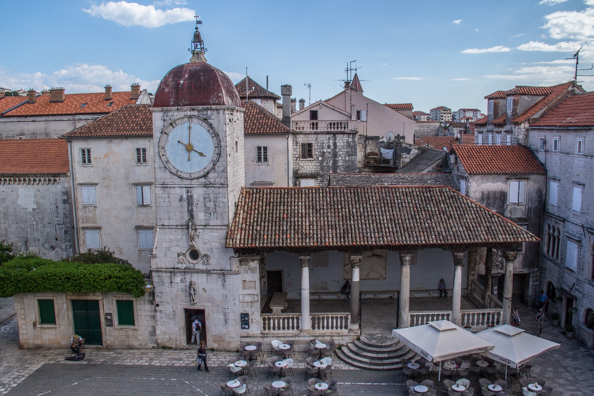
On the other side of the square is Saint Sebastian’s church. It was built in 1476 as a votive church or an offering given by the citizens of Trogir to give thanks for their deliverance from the plague. The front of this Renaissance building is decorated with sculptures of Saint Sebastian and Christ the Saviour. Next to this church is the City Clock Tower, famous for its large blue face. Its domed roof was taken from the church in the middle of the fifteenth century. The City Loggia is next to the clock tower. The loggia was once level with the square but is now accessed by steps. The loggia was built sometime during the fourteenth and fifteenth centuries when it served as a court. It once served as a court but now is an open space featuring a relief of Petar Berislavic of Trogir (a viceroy) by Ivan Mestrovic. There is an empty space where once the Lion of Venice was displayed. When the Venetians moved out the Croatians destroyed all the lions of Venice. Well, nearly all. In the courtyard of the fifteenth century City Hall at the far end of the main square there is a well decorated with the winged lion of Saint Mark of Venice
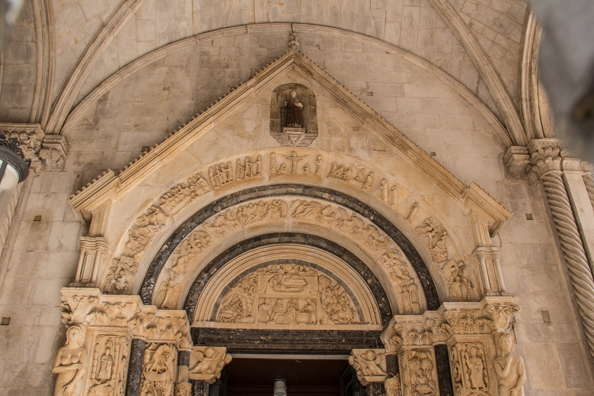
As I left the cathedral I paused to look back at its main entrance. A beautiful Romanesque door that was carved by Master Radovan in 1240 and generally referred to as Radovan’s Portal. This impressive entrance is flanked by two stone lions.
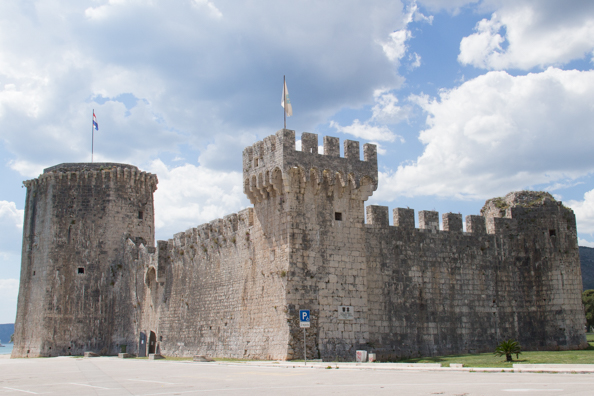
I left the old town through the South Gate or porta civitatis., still complete with wooden doors. These doors used to be locked every night and just outside this gate is the Small Loggia. This was built as a shelter for those who missed the curfew and got locked out of the city at night. It does not take long to walk around the exterior of the walls. Kamerlengo Castle dominates the tip of the island. It was built by the Venetians to defend Trogir in the early fifteenth century. It also served as the governor’s palace for a while. Today the caste has found a new lease as its courtyard is used as a venue for outdoor performances during the summer months. Beyond the castle is Saint Mark’s Tower. This circular tower post-dates the castle. It was built by the Venetians to guard the narrow channel between the island and the mainland. Trogir is a very interesting town and thoroughly deserves its recognition as a UNESCO world heritage site in 1997.
The Town of Dubrovnik in Dalmatia
Dubrovnik is a town of three levels. The old town accessed through Pile Gate is one of four gates that penetrated the old city walls. Just inside this is one of three access points on to the walls. The path around the city walls of the old town of Dubrovnik is a complete circuit of its forts, bastions and towers. No other city in the world has retained its city walls in such a perfect state and for this reason the town became a UNESCO World Heritage Site as early as 1970. The first fortifications were constructed during the early Middle Ages when Dubrovnik was the centre of a city-based republic, Ragusa.
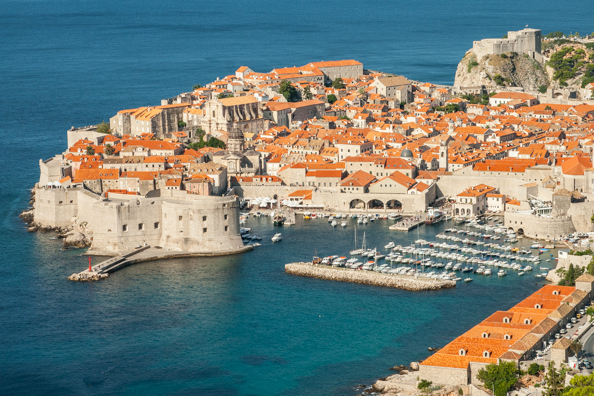
Walking the walls takes the visitor above the crowds that flock into the city every day, mainly from cruise ships that come into Dubrovnik. From my elevated position I enjoyed good views both inside the old town and outside the walls. Lovrijenac Fortress perches on a high, sheer-sided rock in the sea outside the walls. It dates back to the eleventh century. Its purpose was to defend the western part of the city against attacks from both the land and the sea. Nowadays it is the perfect stage for productions during the Dubrovnik Summer Festival.
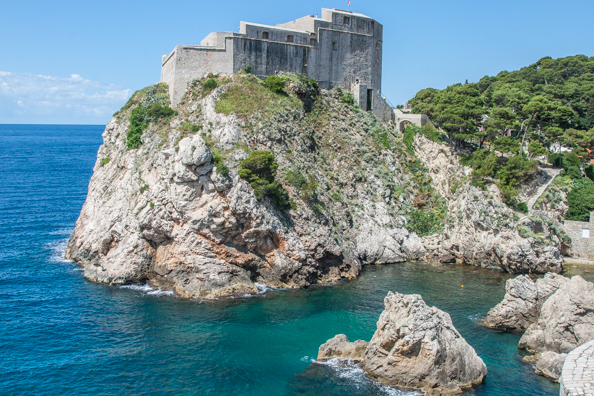
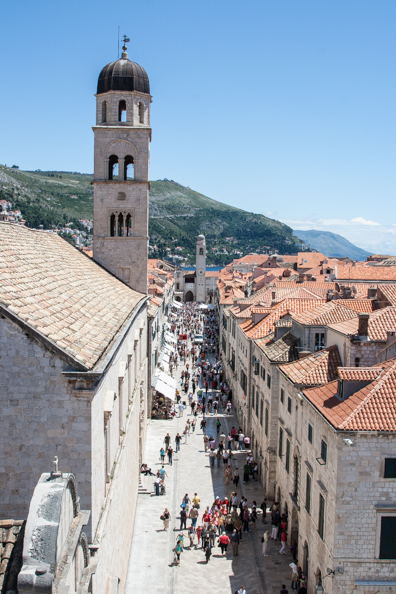
As I circled the walls I planned my tour of the old town. I began at the Old Pharmacy Museum at the top of the main street, Stradun Street. This pharmacy was established by the Franciscan monks as a public pharmacy and still operates as such today. Next door, in the old monastery, is a museum that includes exhibits from the original pharmacy and a bullet hole from the Homeland War (1991 – 1995). Opposite the pharmacy is Big Onofrio’s Fountain. Water was brought into the city by an aqueduct constructed in the mid-fifteenth century. A second, much smaller fountain, Small Onofrio’s Fountain stands under the Bell Tower next to the large, porticoed Building of the City Guard in Laza Sqaure at the far end of Stradun.
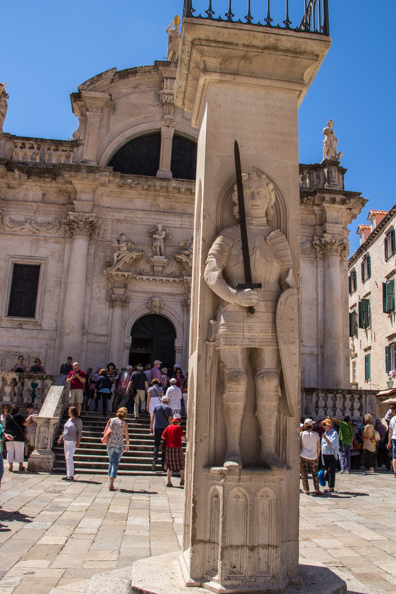
In the same square, Orlando’s Column has pride of place in front of Dubrovnik’s imposing cathedral dedicated to Saint Blaise. Orlando or Roland as he was commonly known throughout Europe was a symbol that the city was under the protection of the Hungarian-Croatian king. The forearm of Orlando was used as a standard measure, the lakat. To ensure accuracy a line on the base of the column represents this measure exactly. at the base of the column.
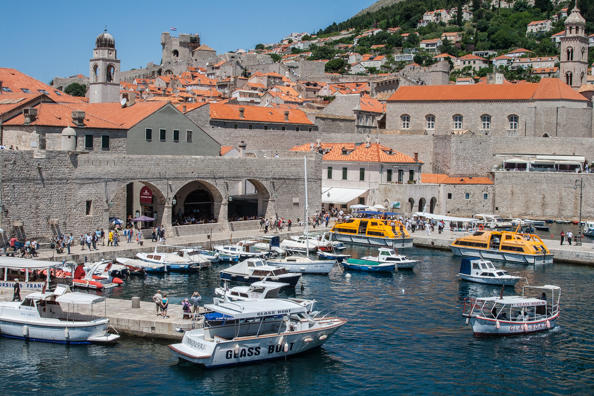
A narrow alley leading out of Luza Square emerges in the Old Port of Dubrovnik. Water once lapped against the walls of the city but when the town was a part of the Austro-Hapsburg Empire a promenade was built around the walls. Visitors the can stroll around the port and admire the Fortress of Saint John. This fortress is now the home of the Maritime Museum and the Aquarium.
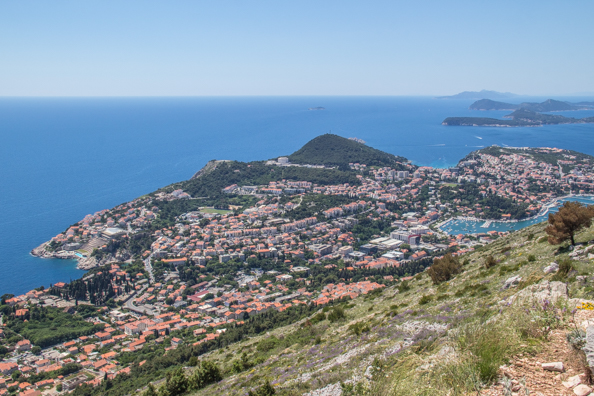
A third tier, Srd Hill, majestically watches over the town. It was Napoleon who built the fort, Fort Imperial on its summit in 1806. This fort was the site of a decisive battle during the Homeland War. It now houses an exhibition dedicated to that war. Today a cable car whisks visitors to the top of Srd Hill. The views from here are amazing. A panorama from Lokrum, an island just outside the old harbour to the Elafiti Islands beyond the new harbour on the other side of the new town. A Dalmatian landscape.
A career break from the legal profession resulted in a career change and since then I have been travelling the world as a tour leader. I started writing about my experiences in 2008 and I have my own blog as well as writing regularly for other websites. I love blogging as it is instant and a great way to showcase my photography – another passion of mine. I write honest accounts of my experiences in the hope they will inspire other travellers. You can read my online travel journal at https://experiencedtraveller.com