Last Updated on August 26, 2021 by Editor G
Try the coffee
My first stop in Ho Chi Minh City was Trung Nguyen Legend coffee shop which offers several varieties of coffee including one of the world’s most famous coffees, the Legendee, commonly referred to as Weasel coffee. This is a unique enzymatically-treated coffee that, apparently, releases flavours from the beans that are not released during mechanical processing.
The official name comes from stories about natives who drank a brew made from coffee beans that had been partially digested by small furry animals that have come to be referred to as weasels but are more likely to have been a civet. This very expensive coffee is now produced by Trung Nguyen using natural enzymes that duplicate the process leaving weasels out of the equation. I settled for a traditional Vietnamese coffee with condensed milk. It was addictive and I started every day of our tour through Vietnam with this invigorating mix. I had not been aware that Vietnam produced coffee so it was a surprise to learn that it is the second largest producer of coffee in the world, second to Brazil.
The French established a thriving coffee industry in South East Asia at the end of the nineteenth century and since then Vietnam has become the leading producer of coffee due to its ideal climate and landscape. Several different varieties of coffee grow well here and this, combined with good roasting techniques has resulted in some excellent coffee.

Visit Notre Dame and the Old Post Office
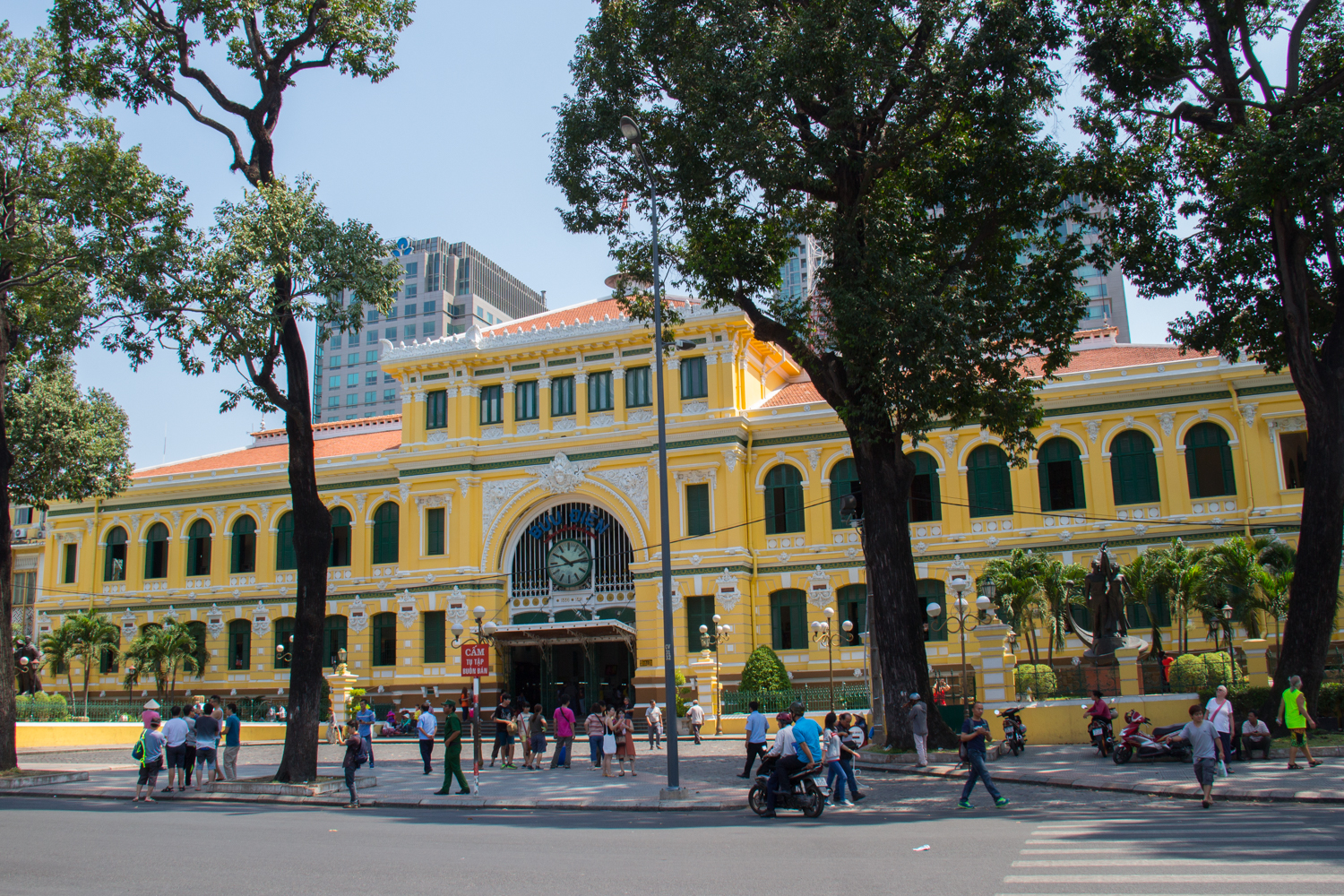
The French have also left their mark on the town centre. Notre Dame Cathedral, that was once called Saigon Church, is a Catholic stronghold in a largely Buddhist country. It was built by French colonists in the 1880s but only given the name Notre Dame after the statue Peaceful Notre Dame was installed in 1959. In 1962 the Vatican granted the cathedral basilica status and conferred on it the official title Saigon Notre Dame Cathedral Basilica. It was built using bricks imported from France and has two towers housing six bronze bells. A stature of the Virgin Mary stands in front of the Cathedral. It is claimed that the Italian marble sculpture shed tears in 2005. On the other side of the square is the splendid Post Office that was designed by Gustav Eiffel and looks more like a grand railway station. The interior of the building is still splendidly colonial and bustling with people engaged in traditional post office business.
Explore the Re-Unification Palace
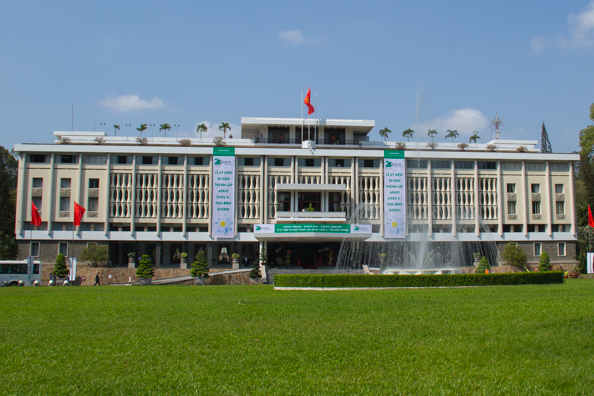
Reunification Palace, a large, plain building achieved fame in 1975 when, to signify the end of the Vietnam War, a tank from the North Vietnam Army crashed through its main gate. Two of the tanks that were used then are parked in the grounds. Inside time stands still as the Palace remains as it was when it was captured. There are five floors of very similar state rooms and bedrooms with access to the roof where a helicopter is on display. The tunnels below the building still house the command centre of the war. Maps are still displayed on the walls, old-fashioned phones sit on desks of the period and a display in one of the rooms tells the story of the Vietnam War – from the point of view of the South Vietnamese.
Peruse the War Remnants Museum
The War Remnants Museum is, as it’s name implies, a collection of artefacts from the Vietnam War http://www.history.com/topics/vietnam-war from the planes parked outside to the exhibits inside. The cool air-conditioning indie was a welcome relief from the fierce heat outside and it was also an opportunity to learn more about the effects of Agent Orange the effects of which are still evident in deformed beggars and musicians we came across on our travels.

Browse the stalls in the Ben Thanh Market
The famous Ben Thanh Market proved not only to be a good place to shop but also to change money at the jewellery stalls at good rates. The exterior of this indoor market was a riot of colour as it is lined with flower shops and fruit and vegetable stalls. Inside the maze of alleyways are confusing until you realise that each one features a particular commodity and it was not long before I found a lane of jewellery shops. Their money changing activities were not evident so I made enquiries. The first stall only dealt in US Dollars but his neighbour was happy to exchange my Baht. On my way out of the market my attention was attracted by some beautiful dragon fruits lit up by a shaft of sunlight. Its soft white interior speckled with small black seeds had featured in every meal so far but had proved to be tasteless.

Go to the Cao Dai Divine Temple
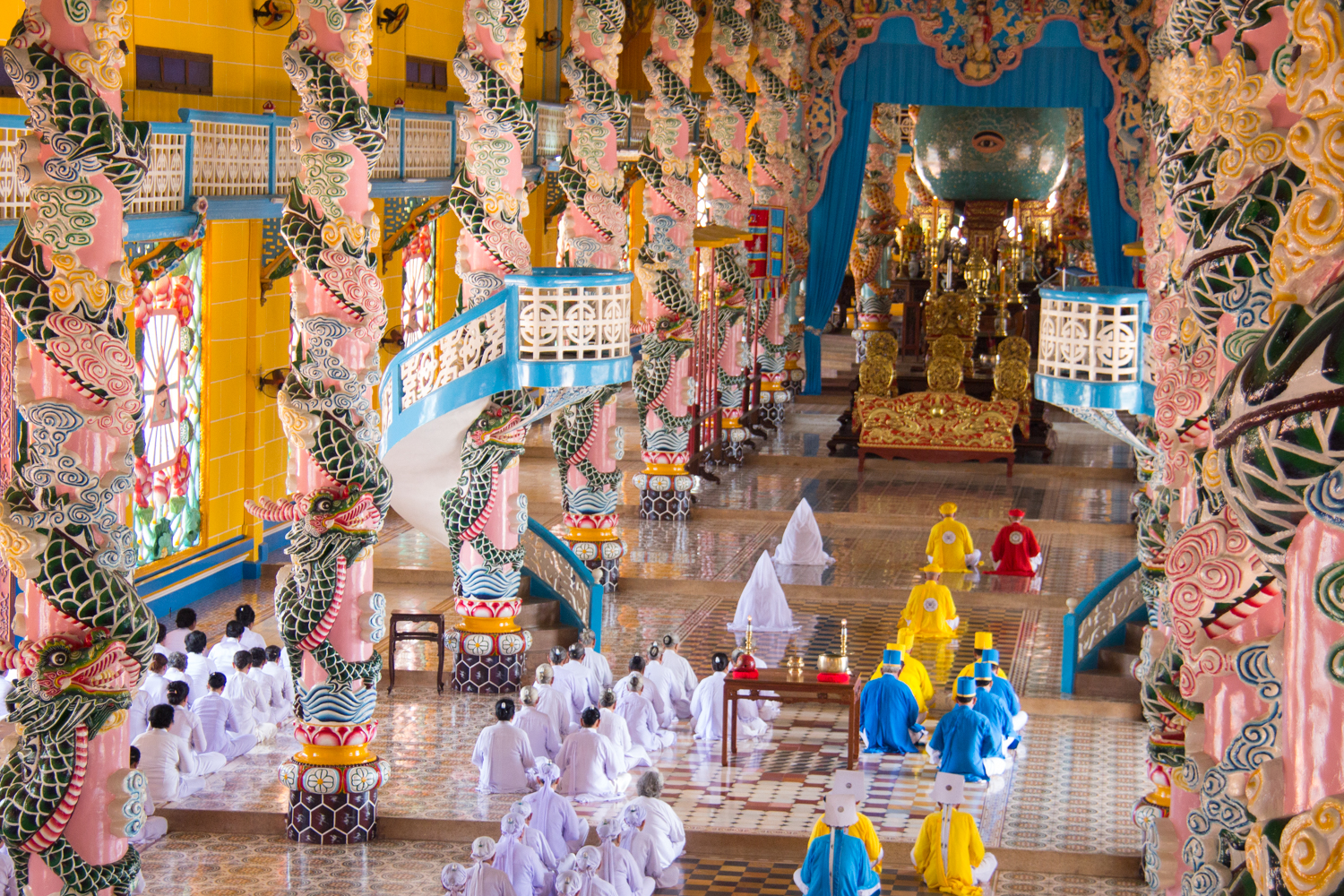
The Cao Dai Divine Temple in Tay Ninh an hour’s drive from Ho Chi Minh City. Cao Dai or Caodaism is a new religious movement that was founded in in Vietnam and officially established in the city of Tay Ninh in 1926. This religion embraces ethical precepts of Confucianism, occult practices of Taoism, theories and Karma and Rebirth from Buddhism and an organisational hierarchy from Christianity. The latter inclusion may explain why its place of worship resembles a large cathedral rather than a traditional temple. It is believed that the founders of this religion were spoken to by God who told them to establish a new religion that would start the Third Era of Religious Amnesty and the ultimate goal of a Caodaist is to re-join God the Father in Heaven.
The interior is an extravaganza of dragon-draped pillars that run the length of the nave to the focal point, a large globe decorated with the Divine Eye (representing God). Visitors are allowed inside the temple but must adhere to strict rules according to the areas they are allowed to walk in – which depend on the time of day. Indeed, the whole religion seems to be governed by a plethora of rituals and ceremonies. We had timed our visit to coincide with one of the four daily ceremonies which was due to start at noon. We intended to watch from the gallery but it was closed until fifteen minutes before the ceremony started. When the gates to the gallery were opened there was a surge of visitors up the stairs. At the top we were met by a very officious steward who told us exactly where we should stand and was not averse to shoving us into position.
The central area of the gallery was reserved for the musicians and the choir that would be performing during the ceremony plus relatives of deceased members of their family they had gathered to honour. At the appointed hour the worshippers filed into the hall below us and took up their positions – ladies to the left and men to the right. The lay followers wear pure white robes and the men with the rank of priest and higher wear brightly coloured robes that reflect their spiritual allegiance – yellow for Buddhism, blue for Taoism and red for Confucianism.
The bishops and cardinals have the Divine Eye emblazoned on their headpieces. All the worshippers had their backs to us throughout the half-hour ceremony and it was not long before I began to wish I had stayed on the ground level and peeked through the side entrances to observe the ceremony. But there was not a lot to observe once they had all processed into the temple and taken up their position there was very little movement.
Crawl through the Cu Chi Tunnels
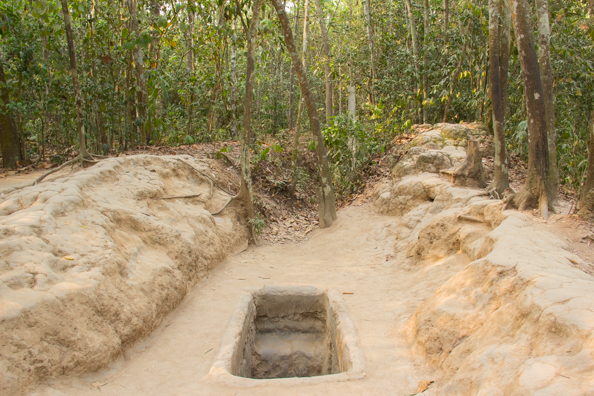
A visit to the Cu Chi Tunnels can be combined with a visit to the Cai Dao Temple. This amazing complex of underground tunnels was used by the Viet Cong during the Vietnam War. More than two hundred kilometres of tunnels connect underground hideouts and shelters. Sections of some tunnels have been widened and heightened so that visitors can walk through them. The display of lethal traps and instruments of torture was disconcerting and the barren land around us was a stark reminder of the effects of Agent Orange which the Americans had used to expose the tunnels by denuding them of their jungle cover.
Marvel at the giant Buddhas at Vinh Trang Pagoda
The Vinh Trang Pagoda, is situated in a large garden in the My Phong commune in My Tho, a town in the Tien Giang province. It is not unusual to find pagodas constructed on private property and Vinh Trang was built by Mr and Mrs Bui Cong Dat in the early nineteenth century. In 1849 the pagoda came under the management of a Buddhist Priest from Giac Lam Pagoda in Ho Chi Minh City. He made some changes to the structure and gave it the name Vinh Trang Pagoda. It is built in a mixture of Chinese, Vietnamese and Angkor (Cambodian) architectural styles. There are five buildings, two ornamental courtyards, nearly two hundred pillars and the graves of Buddhist priests who have taken care of the pagoda. But most impressive are the giant statues of Buddha in three different poses – sitting, lying and standing.

Drift through the Mekong Delta
After travelling by couch to My Tho we boarded a boat on the banks of the Tien Giang River and chugged down the wide muddy brown river lined with fishing boats on either side until we turned into a narrow, shallow channel in the delta. This channel was overhung with thick vegetation and through the gaps we could see a wide variety of crops including coconuts, pineapples and other exotic fruits growing in the fertile soil of the delta. Our first destination was a local workshop where handicrafts and coconut sweets are made and crocodiles are raised to sell for their meat and skin.

After sampling some exotic fruits, drinking the local tea sweetened with honey (delicious) and listening to some local musicians and singers performing traditional songs we were on our way again. A short walk through the small-holding brought us out onto a road where some pony traps were waiting to take us to our next stop, a jetty on another channel. Here we were transported by sampans back to the river where we re-joined our original boat. Back on board our original boat we travelled the short distance to our lunch venue, the Mientay River Side Restaurant where the dish of the day was Elephant Ear fish.
The whole fish was placed on the table for us to admire before being taken away to be cut up and laid on green leaves that were rolled up and then wrapped in rice paper. These parcels were then dipped in a fish sauce before being eaten. It was very pleasant sitting on a veranda over-looking the river on one side and a beautiful garden on the other.

Try the Pastries
The pastries look delicious and tempting but can be on the dry side as I discovered when I treated myself to a green tea sponge cake. But it is pretty!

> You might also like our guide to active things to do in Thailand
A career break from the legal profession resulted in a career change and since then I have been travelling the world as a tour leader. I started writing about my experiences in 2008 and I have my own blog as well as writing regularly for other websites. I love blogging as it is instant and a great way to showcase my photography – another passion of mine. I write honest accounts of my experiences in the hope they will inspire other travellers. You can read my online travel journal at https://experiencedtraveller.com