Last Updated on February 24, 2017 by Valery Collins
Miyajima Island
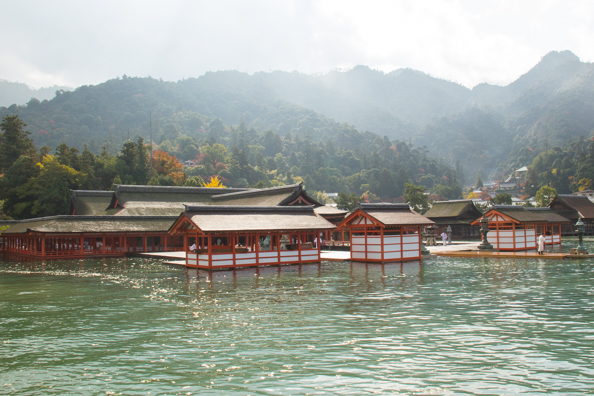
Everyone should visit Hiroshima once in a lifetime. Not only to see what happened there but also to learn that hope (for peace) does spring eternal. With my JR Rail Pass I could anywhere but I chose Hiroshima. An added bonus was that I could also visit one of Japan’s most beautiful places, Miyajima Island. The island is famous for the Itsukushima shrine whose red gates appear to float on the sea. At high tide the whole shrine seems to be in the sea and visitors sometimes have to wait while the water is brushed back into the sea before they can enter.
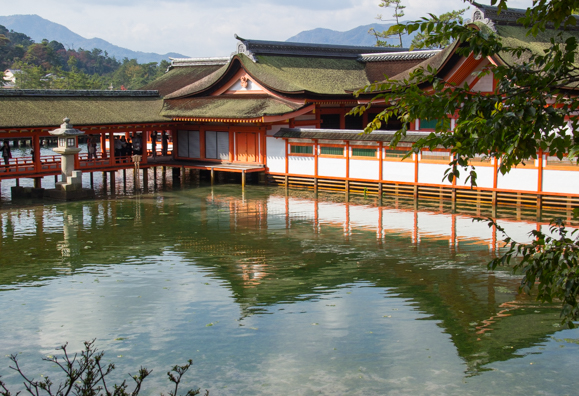
I had a great view of the shrine from the ferry and once I had acquired a map from the information point at the ferry terminal I set off to explore further. A short way along the shore I was enticed into a shopping street lined with traditional buildings. Here I found an abundance of momiji manju the famous pastry of the island. Reputedly this pastry was created over a hundred years ago when the manager of a Ryokan (Japanese style inn) on the island asked a Japanese pastry chef to make something special for Miyajima.

A short walk up the hill brought me to the Toyokuni Shrine or Senjokaku. The name means hall of one thousand tatami mats. These traditional floor coverings are used in homes, restaurants, temples and even boats throughout Japan. It is considered disrespectful to walk on these mats in shoes. not permitted to walk on these mats in shoes. This shrine was built five-hundred years ago and dedicated to Toyotomi Hideyoshi one of the three unifiers of Japan during the sixteenth century. It is the largest structure on the island and from its elevated position visitors can appreciate lovely views of the island below. Next to this shrine is the majestic Five Storied Pagoda. Also known as Goju-no-to this pagoda was built in 1407 and restored in 1533 and 1945. Originally it enshrined the Buddha of Medicine and the Buddhist saints Fugen and Monju. These images were removed in the early Meiji period and are now enshrined in the Daiganji Temple, also on the island.

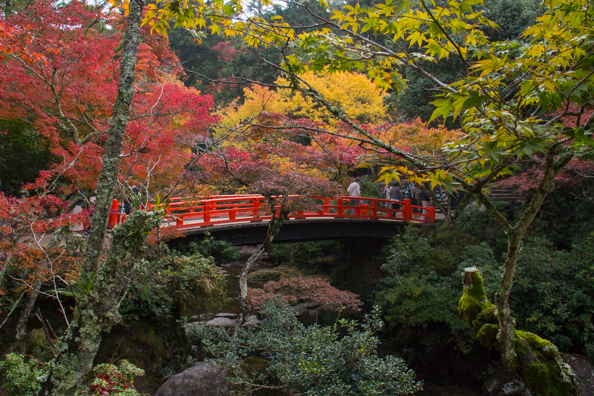
Momijidani (Maple) Park was clothed in splendid autumn colours when I strolled through it. This beautiful park is criss-crossed by paths occasionally suspended on red bridges over the Momijidani River that runs through it. The park is home to the deer that inhabit the island but they also wander down to the waterfront in search of tit bits.

I was tempted to go to the top of Misen Mountain on the aerial ropeway and headed for its station. I had almost reached the bottom of the cable car when I discovered that tickets have to be bought before entering the park. I abandoned that idea as there was plenty to see in the park.
On my way back to the ferry I passed several stalls selling another local delicacy, baked oysters. Oysters have been farmed around the island for over three-hundred years. Every February this is celebrated by an oyster festival. I love fresh oysters but had never tried a baked oyster. a I settled for a deep fried bread roll filled with curry and pieces of baked oyster. It was delicious.

One last look at the beautiful exterior of the Itsukushima Shrine. It’s orange and white buildings mirrored in the water that surrounds them. I continued to the ferry terminal and got the next ferry back to the mainland.
Hiroshima Peace Park
The Atomic Dome (Genbaku Dome) at the entrance to the Peace Park in Hiroshima was the only building left standing in Hiroshima after the first atomic bomb exploded there on 6 August 1945. Its shredded roof is a stark reminder of the devastation it caused. The murmur of hushed voices is the only sound I can hear as I struggle to appreciate the enormity of the disaster.

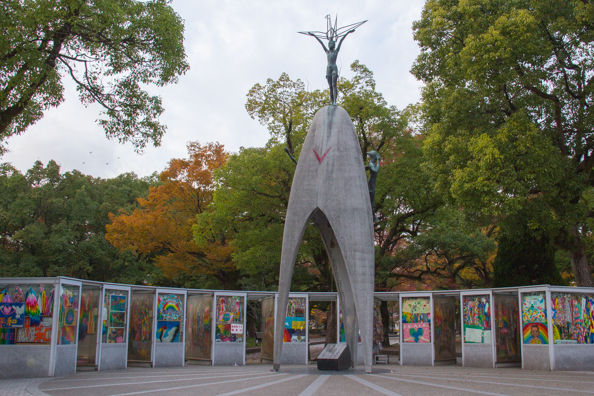
Over the river the atmosphere is completely different. The park with its scattering of meaningful memorials. A group of noisy children drew my attention to the Children’s Monument. I was curious about the crane-shaped bell inside it. This bird is a symbol of peace and origami cranes are folded worldwide as a wish for peace. The origin of this tradition can be traced back to a girl named Sadako Sasaki. She was exposed to the Atomic bomb and contracted leukaemia. She believed that folding cranes would help her recover but sadly it did not. Her suffering and that of all the children who were killed by the bomb is remembered by the tolling of this bell.
Close by another bell was ringing – the Peace Bell. This monument also features a pond planted with lotus seeds that flower every year on Peace Memorial Day. They commemorate the use of lotus leaves to soothe the burns of the injured. There were hardly any medical supplies available following the blast.

The centrepiece of the park is the Cenotaph and the eternal flame. It is said that this flame will be extinguished when the last atomic bomb in the world has been destroyed. Through the arch of the cenotaph I could see the Atomic dome – a constant reminder.

Behind the Memorial to all the Koreans killed by the bomb is the Korean Memorial Hall. A reminder that thousands of other nationalities died here and the majority were Korean conscripts. In this hall a video runs all the time with images and recordings as survivors of the attack recall their experiences. It is heart-breaking to listen to them.

The Peace Museum occupies two large buildings at the far end of the park. But I did not go inside preferring to spend more time enjoying my lovely surroundings outside. The park is well established in the new city of Hiroshima. It has become a popular place for locals to relax. I was happy to join them for a while to reflect on the range of emotions I had experienced during my visit.

Getting There
My JR Rail Pass got me all the way there and all the way back from Kyoto where I was based on the Shinkansen (bullet train). Five companies run the Shinkansen or bullet train but the JR Rail Pass is only valid on three of these companies. The pass is not valid on services run by Nozomi and Mizuho I had to study the train timetable carefully to make sure I used the right train. If any part of my journey was covered by a train not covered by the pass I would have to pay for the whole journey which would be very expensive. There was a train to Hiroshima from Kyoto where I was staying, at 07:20 which was perfect and one back at 19:03 – also good timing. Outbound the train was direct and the inbound involved one change but only a ten-minute wait. Two days earlier I had reserved seats on all the trains I was using at the JR office in the station. My journey was very pleasant as the seats were comfortable and constant announcements and screens in each carriage kept me informed regarding the progress of my journey. There was a refreshment trolley on the trains but I had already eaten well in a rustic restaurant at the station – baked oysters, ginger pork, boiled rice and miso soup.
A career break from the legal profession resulted in a career change and since then I have been travelling the world as a tour leader. I started writing about my experiences in 2008 and I have my own blog as well as writing regularly for other websites. I love blogging as it is instant and a great way to showcase my photography – another passion of mine. I write honest accounts of my experiences in the hope they will inspire other travellers. You can read my online travel journal at https://experiencedtraveller.com