Last Updated on July 3, 2016 by Editor G
The Town of Luang Prabang
In Luang Prabang time seems to have stood still. Certainly the traffic stands still to let pedestrians cross the road. An unusual occurrence in Indochina. Its pretty streets are lined with French colonial houses punctuated with Buddhist temples. Once the Royal capital of Laos, Luang Prabang it is now its main centre of Buddhism the religion to which most of the population subscribes.
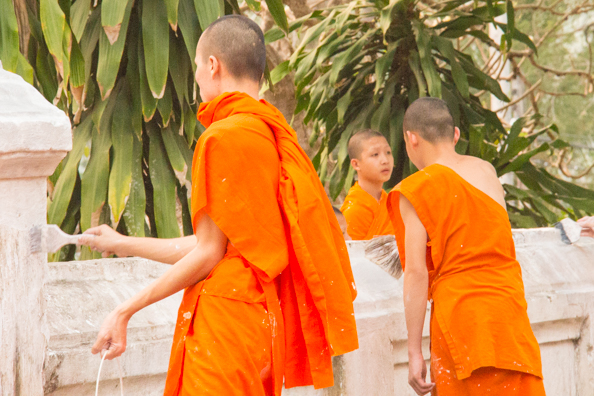
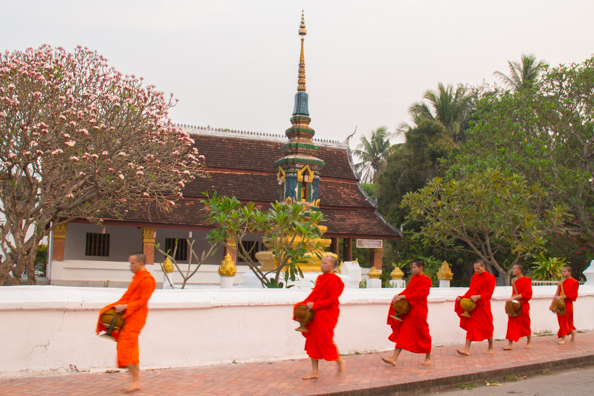
In Laos ordination as a monk is considered an honour and not long ago all Lao men followed the tradition of ordination. Now the numbers are decreasing. This is hardly surprising as ordination requires compliance with a multitude of rules. However, there are no rules relating to the length of time an ordained monk must serve in is religious order and it varies from a few weeks to a lifetime. Monks preside over religious ceremonies, festivals, funerals and other rituals. They do not have any personal possessions and they rely on donations from the local community for food and clothing. At dawn every morning the almsgiving ceremony takes place. This is not a tourist-driven attraction but they can attend and watch or take part provided they obey the rules!
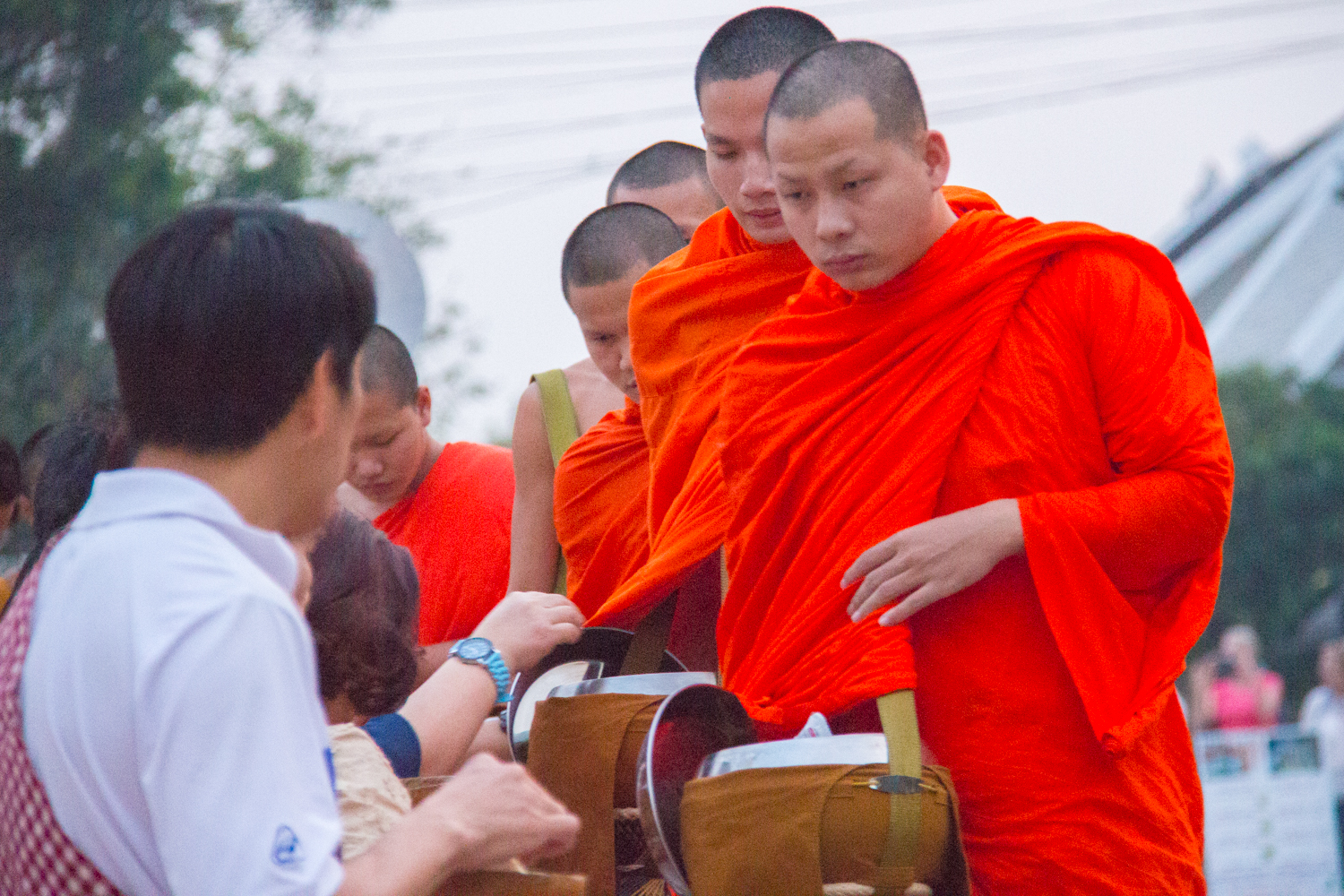
When I took part in the ceremony I gave alms (sticky rice and snack bars) provided by our guide, Pom, who had been a monk for fourteen years. I was positioned outside Wat Sene Souk Haram also known as the temple of one hundred thousand treasures. Built it 1718 using one hundred thousand stones from the Mekong River it is one of the most beautiful temples here. The temple complex includes a drum and a pirogue (dugout canoe) shelter that houses a beautiful racing pirogue. This monastery was the first to adopt the Thai fashion by covering its main building with yellow and red tiles.
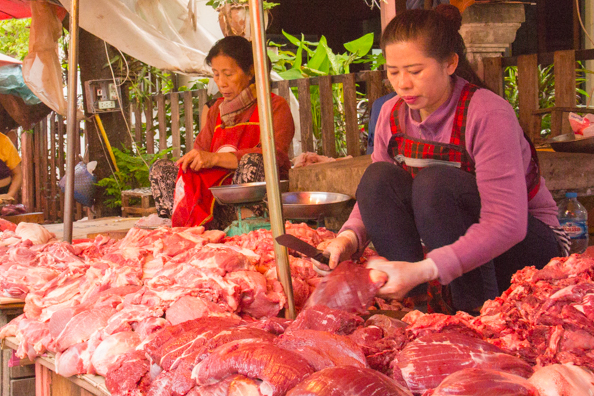
There was still time to visit the morning market before returning to our hotel for breakfast. We walked there through deserted streets. This market occupies both sides of the street it stretches along. I was already aware that the Lao like their food as fresh as possible but I did not expect to see some of the produce still wriggling and kicking. containers and live fish thrashed their tails in buckets of water. This is where the locals shop daily for their food and it is an assault on the senses – smell of fresh corn being grilled, sound of stall holders and customers bargaining and the sight of an astounding array of edible items.
The temples of Luang Prabang reflect different eras and diverse styles. The oldest temple is Wat Visounarth. In the Lao language Wat means a Buddhist temple. A Wat is not a single building but a complex of buildings usually surrounded by a wall. The sim is the main building and houses the statues of Buddha. Most temples also feature accommodation for the monks associated with it. Wat Visounarth was built by King Wisunarat and dates back to 1513. Towards the end of the nineteenth century the original wooden building was burnt down by the Black Haw riders part of the rebel Chinese Black Flag army intent on ransacking Laos. This temple was a good example of early Lao architecture. When it was rebuilt some of the original parts were incorporated into the new structure. Later restorations have taken place. Its sim houses a selection of gilded statues of Buddha and some ancient stones. It’s most unique feature is the unusually shaped stupa. Designed by the wife of King Wisunarat to represent a lotus flower the locals obviously do not appreciate her artistic efforts as they call it the watermelon stupa.
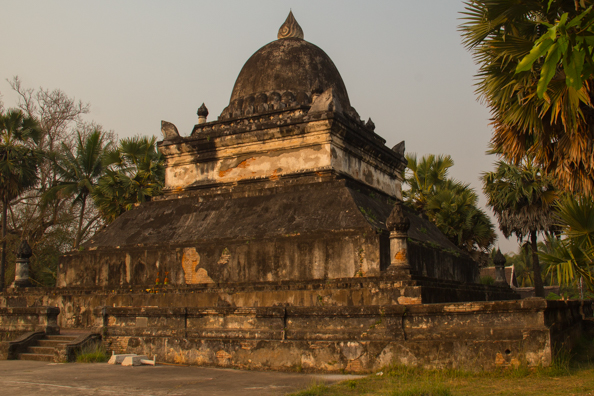
Wat Aham Qutama Thang temple is a Buddhist temple with a history of both Buddhist and spirit worship. According to legend the site on which this temple was built was originally occupied by two shrines built for the two guardian spirits of Luang Prabang, Pu No and Na Na. Two centuries after these shrines were built they were destroyed by King Phothisarath a devout Buddhist dedicated to eradicating the worship of spirits. He built a temple on the site. Soon after the temple had been completed the town was hit by several disasters including plague, drought and failed harvests. Its citizens were convinced this was a consequence of the destruction of the shrines. The next king re-built the shrines but they were destroyed again in the twentieth century. The present temple was built in 1818 and between the street and this temple are two large, old banyan trees in which, it is believed the spirits have taken up residence. The steps flanking the entrance to the sim here are guarded by tigers. Next to the tigers are two characters from Phra Lak Phra Ram, the Laos version of the Indian epic Ramayana. Its main characters are Hanuman and Ravana.
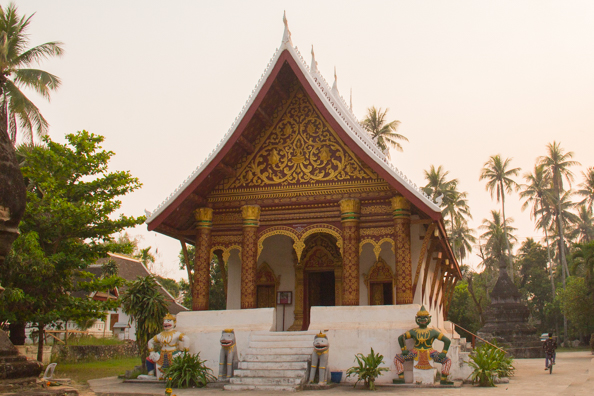
Situated above the Mekong River Wat Xiang Thong, also known as the monastery of the golden city, was once the gateway to the town for visitors arriving by boat. It is one of the highest symbols of Buddhism in Laos and the religious emblem of Luang Prabang. It was due to its elevated status, both geographical and religious, that it was spared destruction by the Chinese Black Flag army. The sim, is a wonderful example of classic Luang Prabang architecture. All twenty buildings in this complex are considered to be architectural gems. It was the place where the designated king would enter the city on the eve of his coronation after three days of prayer and meditation. The royal family made many changes while it was under their patronage. And since then it has undergone several restorations including one subsidised by the French in 1928. It is now a major for tourist and pilgrims many of whom come to admire its ornate tree of life which means different things to different cultures.
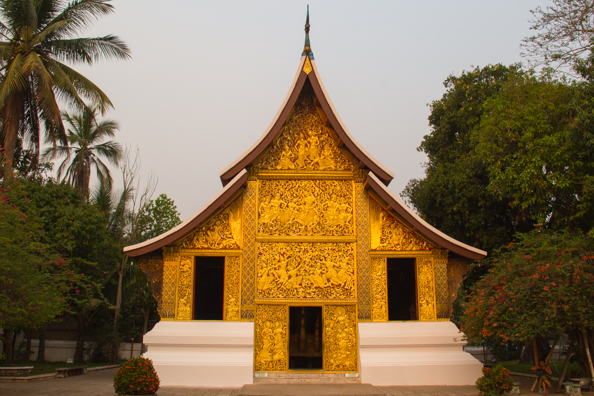
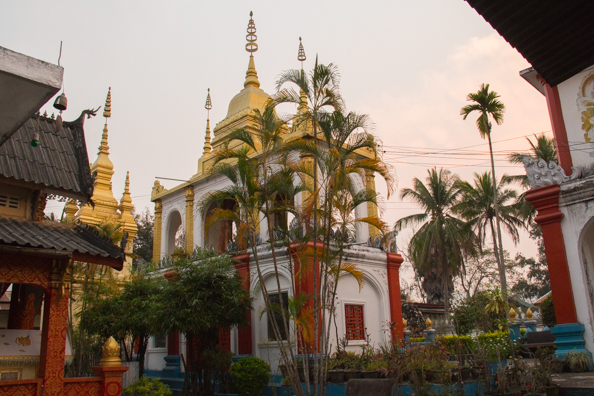
Wat Prabaht Tai on the banks of the Mekong River is a good place to watch the sun setting over the river. This unique and colourful monastery combines elements of Thai, Lao and Vietnamese architecture with a hint of European historic religious architecture. It was on this site that the Naga King, Chai Chamnong, was thought to have inhabited a rock from which he could protect the rivers that flowed around the town. When a huge footprint of the Buddha was found here this was deemed to be permission to build a monastery. A monastery still guards the footprint but the original building has been replaced by by the Vietnamese and Chinese communities.
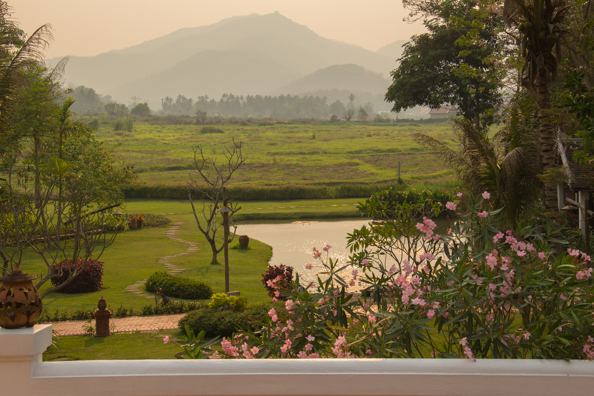
During my stay in Luang Prabang I was based at the Santi Resort and Spa in its lovely garden setting on the outskirts of the town. As the hotel runs a free shuttle service into the town it was easy to get there to sample traditional cuisine in the local restaurants. It was a dilemma each evening – eat in or eat out. The food in the hotel was as good as any I sampled in the town and beautifully presented. And the setting, a veranda with views across the garden to the hills beyond was almost irresistible.
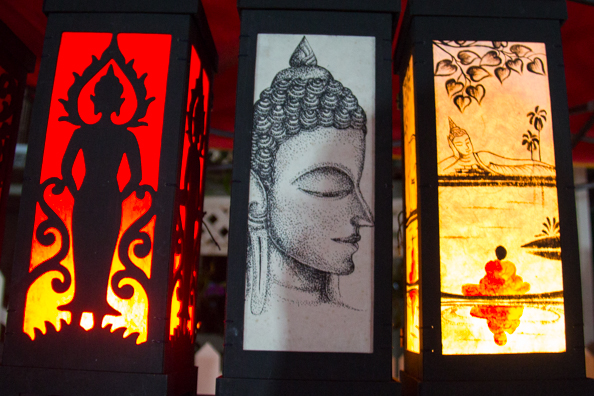
A stroll through the night market was a good lead-up to dinner in town. This market occupies a whole street which is closed to traffic while it is open. An amazing variety of goods are pile up on the stalls which are manned by courteous sellers – no hassle, which was refreshing. I managed to resist a mouth-watering iced doughnut but felt compelled to buy one of the unusual hand-woven scarves. I was fascinated by the decorated lamps that lit up the stalls and the streets but had to be content with a picture of them.
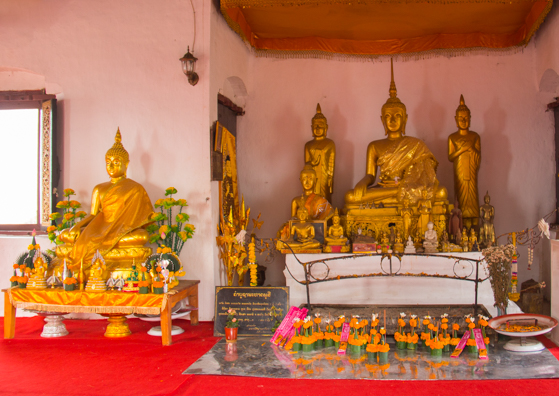
Overshadowing Luang Prabang is the Vat Phousi Hill or Mount Phousi. An early morning ascent up the one hundred and fifty metres of the Thanon Phousi staircase is rewarded by great views of the town and its two rivers, the Mekong and the Nam Khan. These steps are lined by sellers of flowers and small birds in basket weave cages. The flowers will be offered to Buddha in Wat Chomsi perched on the top. And the birds will be set free because the Lao believe that this will bring good luck and happiness. Some believe that the this hill has ancient roots in the Ramayana which relates how the Hindu monkey god Hanuman moved the mountain from Ceylon (Sri Lanka) to its present position.
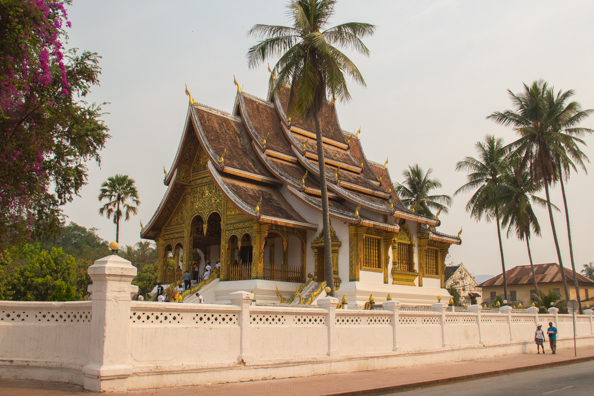
At the foot of Mount Phousi is the Royal Palace or Haw Kham that has been preserved as a museum. Luang may no longer be the royal capital but, designated a UNESCO World Heritage Site in 1995 this tiny town is considered to be the heart of Laotian culture. It ceased to be the Royal capital due to threats from neighbouring countries, Myanmar (Burma) and Thailand, and Vientiane became the administrative capital in 1545. Luang Prabang is the more popular destination for tourists. And no wonder with its beautiful old buildings and inherent charm. The Royal Palace or Loyal Palace is no exception. All the buildings in the complex appear to have been left as they were when housing the last royal family. This palace was built by the French in 1904 to replace a smaller teak and rosewood palace. King Sisavangvong insisted on modifications and substituted the stupa-like spire resulting in a fusion of European and Lao design. The exhibits inside are much older than the building and illustrate the turbulent history of the Lan Xang Kingdom. The immaculate grounds are also the site of Hor Prabang (a temple), a new exhibition hall and a large bronze statue of King Sisavangvong.
The Environs of Luang Prabang
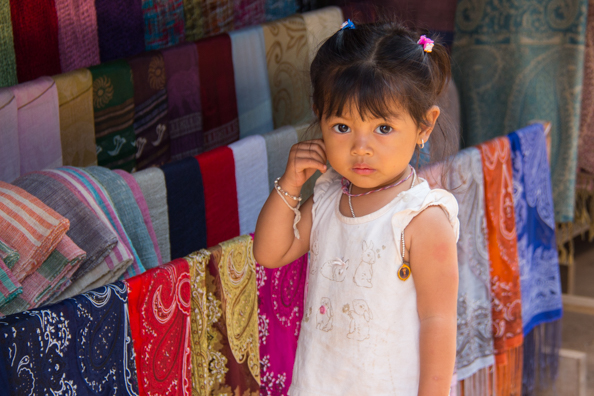
As the Mekong River flows through Luang Prabang a river cruise is a very popular day out. Our long, narrow pleasure boat nosed its way through the muddy waters. Its passengers sat back to enjoy a cooling breeze and the agricultural scenery on both sides of us. We stopped to explore the whisky village, Ban Xang Hai. For centuries the villagers have made the clay jars used to ferment Lau Hai Lao wine. Now they also specialise in the production of Lau Lao Lao rice whisky which they ferment in the clay jars. Rice soaked in river water is left to ferment in these jars for several days. The alcohol that results from the can either be drunk as a cloudy liquid or distilled to make a clear liquid. After trying different flavours of the distilled version we had a walk around the village temple and then strolled along an avenue of stalls selling a mixture of hand-woven and imported fabrics.
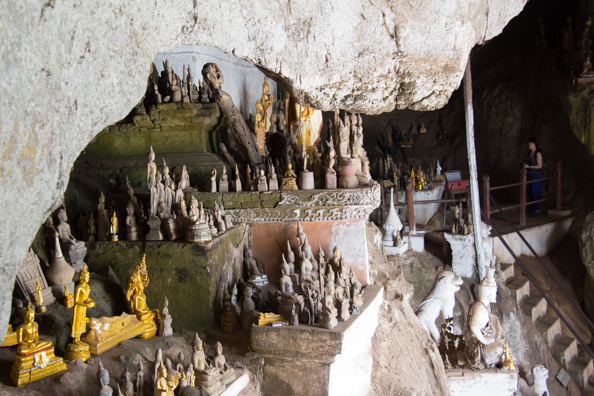
Our boat then traversed the river to visit the famous Pak Ou Caves. These limestone caves penetrate a steep rock cliff rising vertically from the waters of the Mekong River at its confluence with the Nam Ou river. The scenery is stunning – especially from the mouth of the caves. Over the centuries thousands of Buddha images, all different sizes, poses and colours, have been placed in the caves by locals and pilgrims.
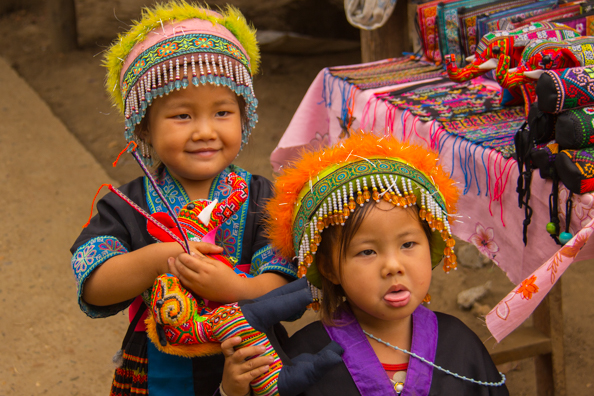
We stopped at a Hmong Village on our way to the Kuang Si Waterfall. The Hmong emigrated to Laos from China during the eighteenth century due to political unrest. A group of precocious children were waiting for us by the roadside when we arrived. Some were dressed in traditional costumes and all of them vied with each other to sell us woven bracelets for one dollar each. It was hard to refuse as their wide eyes would well up with tears if you tried to move on without making a purchase. The one long semi-circular street through this village was lined with stalls all selling similar items.
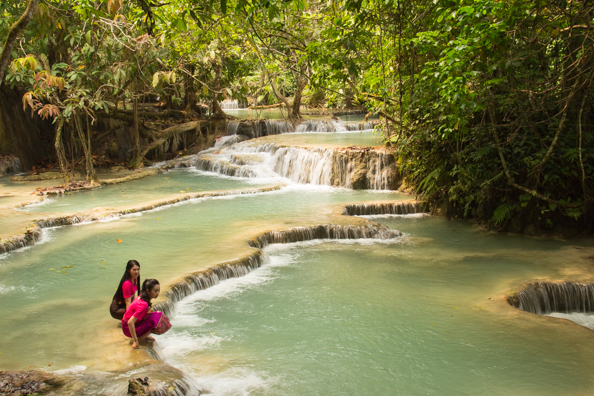
We had been promised a picnic when we arrived at the waterfall. I had visions of eating soggy sandwiches sitting on the ground. But the reality was a three-course meal served at a long wooden table in the shade of some trees right by a waterfall. It was a lovely experience. After eating we strolled along a footpath that wove its way between beautiful pools and cascades of water. A photo-shoot was taking place and several beautiful girls, the finalists of the Miss Laos competition, were posing around the pools.
My time in Luang Prabang was an oasis of peace and calm during a hectic tour of Indo-China. http://experiencedtraveller.co.uk/blog/post/2016-04-24-some-highlights-of-ho-chi-minh-city-saigon-in-vietnam
A career break from the legal profession resulted in a career change and since then I have been travelling the world as a tour leader. I started writing about my experiences in 2008 and I have my own blog as well as writing regularly for other websites. I love blogging as it is instant and a great way to showcase my photography – another passion of mine. I write honest accounts of my experiences in the hope they will inspire other travellers. You can read my online travel journal at https://experiencedtraveller.com