Last Updated on August 9, 2023 by Editor G
Tunisia, nestled in the heart of North Africa, is a tapestry of history, culture, and remarkable architecture that tells tales of civilizations past and present. From the ancient ruins of Carthage, whispering legends of a once-thriving empire, to the iconic ribat fortresses along the coast and the enchanting medinas brimming with life, every corner of this nation beckons with architectural marvels. The fusion of Roman, Berber, Arabic, and Andalusian influences has crafted a unique architectural palette, making Tunisia not just a destination but a journey through time. As you explore its landscapes, you’ll find that every brick and mosaic in Tunisia has a story to tell, awaiting the discerning traveler.
Culture of Tunisia
The country we now know as Tunisia was once the old Roman province of Africa and part of the Roman Empire. Then, Carthage was its most important port, and Tunis was a satellite city in its hinterland. It became an independent unit under the medieval Hafsid dynasty.
When it became part of the Arab world, it was initially known as Ifriqiya and then Tunisia. It shares a language and many cultural elements with the Arab world but still maintains its identity.
Zaghouan
Zaghouan is a small town on the northern side of the Tunisian Dorsal mountains. The modern town was built on the ruins of the Roman town Ziqua. It is believed this name derives from the Latin word for water, aqua.
The region was well-known for its springs. Water was very important in the history of Zaghouan as illustrated by the Zaghouan Aqueduct. The Roman Emperor Hadrian built this in 128 AD to take water to bring water into Carthage from Zaghouan following a five-year drought in North Africa. This aqueduct, a masterpiece of construction, was 132 kilometers long, one of the longest aqueducts built by the Romans. To this day sections of the aqueduct still punctuate the landscape between Tunis and Zaghouan.
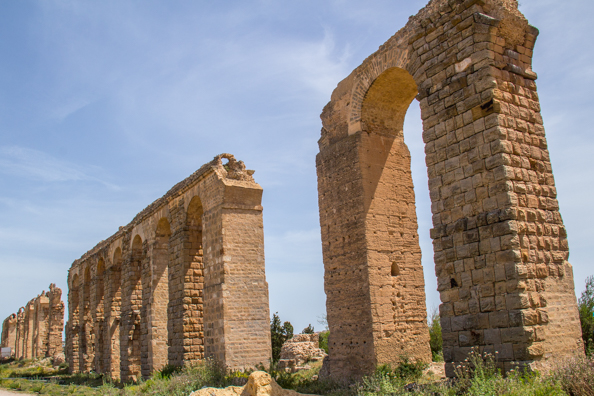
A second testament to the importance of water in Zaghouan is its Roman Water Temple. Built around the springs in 139 AD this temple venerates water as a source of life. Roman scriptures and statues of Roman gods were displayed throughout the temple.
Today it is a popular destination for both locals and visitors who scramble freely among the ruins. Nearby the beautiful architecture of the old town of Zaghouan reflects the influence of the Moors. They settled here during the seventeenth century after fleeing from Spain. The Moors established new methods of agriculture and also developed a new plant species, Nesri or Rosa Canina also known as the dog rose.

Hammamet
The small seaside town of Hammamet is dominated by its kasbah. A kasbah is the citadel of a North African city. Following the decline of the Roman Empire, North Africa became part of the Arab world and was ruled by a succession of dynasties. During the thirteenth century, the governor in Tunisia broke away and formed a new dynasty. The Hafsid dynasty restored order to Tunisia and trade flourished. In the fifteenth century, the Hafsids built the kasbah in Hammamet as a residence for its governor and a garrison for his soldiers.
Today the kasbah, having undergone some refurbishment and renovation still stands proud at the far end of the town’s sandy beach. Its exterior may be imposing but the interior is just a shell. Visitors can climb up on the walls for views of the city and the beach below. Next to the kasbah is the very small medina of Hammamet. A medina is the old town centre whose narrow streets are generally lined with small shops.

Bardo Museum
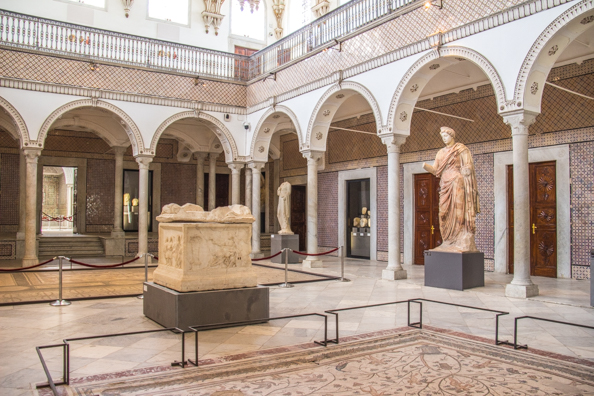
The Bardo Museum on the outskirts of Tunis draws together the strands of history relating to Tunisia’s strategic position on the North African coastline. For this reason, the country was an important part of the Roman Empire. The building that houses the museum is a fifteenth-century Beylic palace and a reflection of Tunisian culture.
Visitors stroll through the beautiful rooms of the palace admiring the artifacts displayed therein. The palace is comprised of the Little Palace and the Great Palace. Inside the Little Palace is the lovely Harem Patio that was part of the Old Harem, and the king’s bedroom was connected to this courtyard.

The Carthage Room is off this courtyard. This huge room features mosaics on the floor and statues around its perimeter. Some of the statues are headless as the bodies were re-used. This museum has the largest collection of Roman Mosaics in the world. It also has a new, modern space for temporary exhibitions.
Colors of Tunisia
Colors often associated with Tunisia comprise white-washed buildings, traditional blue doors, and shutters often complimented by a blaze of brilliant bougainvillaea. Plain exteriors are typical of traditional North African architecture and commonplace in Tunisia. The interiors are ornate and an indication of the wealth of the owner.

However, the doors of traditional Tunisian buildings are very decorative. They are not just a means of forming a barrier between living areas and the outdoors. A traditional door is large and made of solid wood. Sometimes the main door incorporates a smaller door. This acted as a defense mechanism but is also more convenient for everyday users. Generally, these doors were installed in a stone wall and were assembled using nails and large nails. The patterns made on the doors were a means of concealing these nails.

The most common patterns found in the old town centers or medinas are the eye, the fir tree, and the star shape. Other decorations include religious symbols illustrating the various religious groups that inhabited Tunisia. These old doors are usually blue or yellow but other colours are used.
A popular frame for these doors is grey Kadhel, a Tunisian marble. Where a door gave access to an interior courtyard, it would have a high door knocker enabling a visitor on horseback to knock on the door and then enter without having to dismount. Most traditional doors have two door knockers. These make different sounds so the occupants know if their visitor is male or female – male on the left knocker and female on the right.
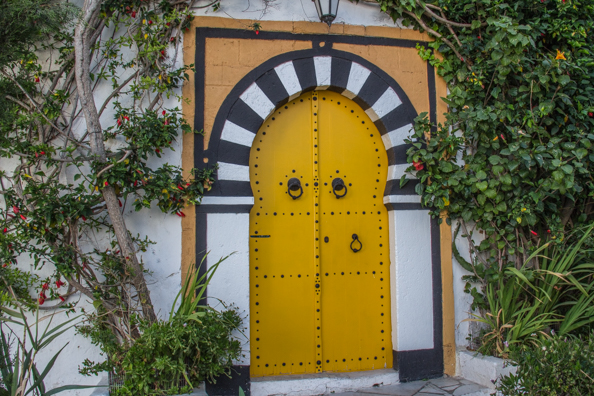
Sidi Bou Said is an outstanding example of the colors of Tunisia. Its narrow, hilly streets are lined with white-washed buildings bejeweled with blue doors and shutters or moucharabiehs. A moucharabieh is made of wood and is built around a window or balcony, protecting it from the sun and the heat of summer. It has panels that can be opened. These panels allow the room it is protecting to be ventilated.
The air passing through a moucharabieh was channeled towards water-filled jars cooling it before it passed into the room. They were the first air conditioners. Islamic women could look out at the city without being seen by passers-by as their tradition demanded.

Crafts of Tunisia
Colorful pottery is probably the craft most popularly associated with Tunisia. Nabeul is considered to be the most important centre for skilled artisans of this art. Ceramics, utilitarian and decorative spill out onto the streets from the many small workshops in this town. Visitors are welcomed inside to watch demonstrations by skilled artisans who have taught their art generations before.
History suggests that the Sumerians invented the manufacture of simple pottery. Later, when the Phoenicians established the city of Carthage they also introduced the manufacture of ceramics and mosaics. This industry flourished, and their craft was inherited by the Romans, who were famous for their mosaics.
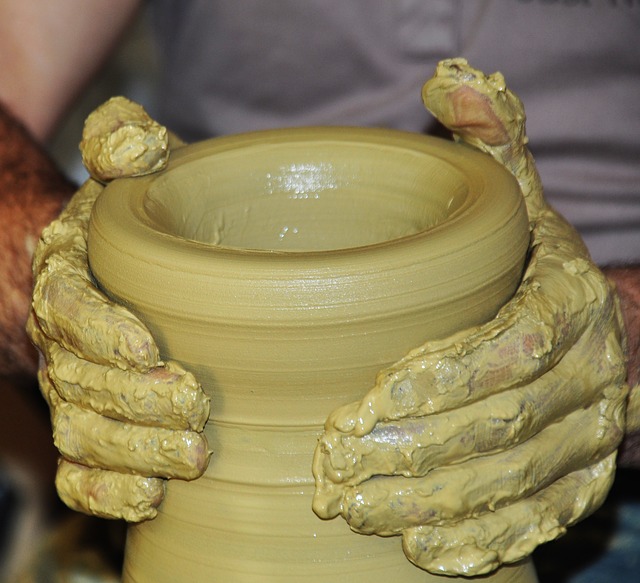
The Romans took the manufacture of ceramics to new heights, and the art continued to evolve with the coming of Islam. When skilled craftsmen arrived from Spain during the seventeenth century, their Andalusian traditions added a new dimension.
A legacy that can still be seen in the brightly colored patterns on the pottery of Tunisia today. Every year Nabeul hosts two international fairs in April/May and at the end of August. The latter is mainly a craft fair featuring domestic and international stalls. Here, many other crafts for which Tunisia is renowned such as perfume bottles, leatherwork, jewellery and wood carving can be seen and admired.

A career break from the legal profession resulted in a career change and since then I have been travelling the world as a tour leader. I started writing about my experiences in 2008 and I have my own blog as well as writing regularly for other websites. I love blogging as it is instant and a great way to showcase my photography – another passion of mine. I write honest accounts of my experiences in the hope they will inspire other travellers. You can read my online travel journal at https://experiencedtraveller.com