Last Updated on May 31, 2016 by Editor G
Gone are the days when a stately home was just a building, a formal garden was just that and a zoo a collection of cages housing animals. Now these attractions have been developed to educate, entertain and excite. And none more so than Blenheim Palace, Kew Gardens and Marwell Zoo.
Blenheim Palace
It was delightful walking through the park surrounding Blenheim Palace, near Woodstock in Oxfordshire, with only wild geese as company. I had arrived early and walked across the grass to enjoy views of the lake from the Grand Bridge from which I had a good view of the palace in front of me. Behind me, in the distance I could see the Column of Victory (1730) crowned by a statue of the first Duke of Marlborough dressed as a Roman general. It was hard to believe that the elegant landscape around, fashioned by Capability Brown, had once been marshland. through which the Glyme stream had wound its way.

Woodstock Park was given to the First Duke of Marlborough following his success at the Battle of Blenheim in 1704. Since then it has become the site of the magnificent Blenheim Palace surrounded by landscaped parkland and several formal gardens. Three centuries later the palace remains the home of the Marlborough family and the current owner is the twelfth Duke of Marlborough. Part of the palace and the grounds are open to the public
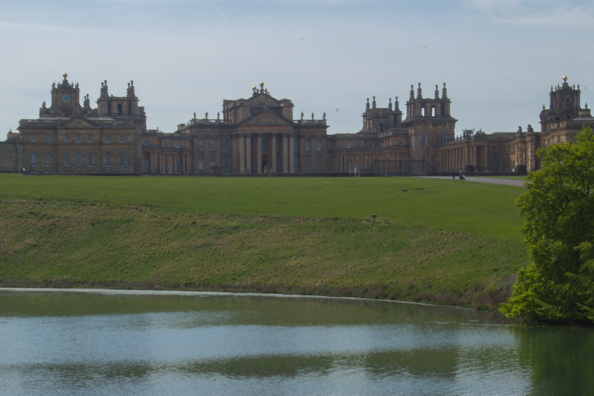
A variety of guided tours of the palace are included in the entrance fee and I joined a tour of the palace state rooms. Alistair was our guide and he was very good at linking the history of the family with the exhibits in the rooms. Discretely placed information boards in each room help visitors to find their own way round. However, a tour with a guide does bring the place to life. I could imagine the family entertaining important guests on Christmas Day in the beautifully set table in the Saloon or state dining room.

After noon tea is served in the Orangery. This beautiful setting is ideal for a delicious tea of delicate sandwiches, scones with jam and cream and scrumptious cakes. There is a wide range of teas and tisanes to choose from or maybe a flute of champagne?

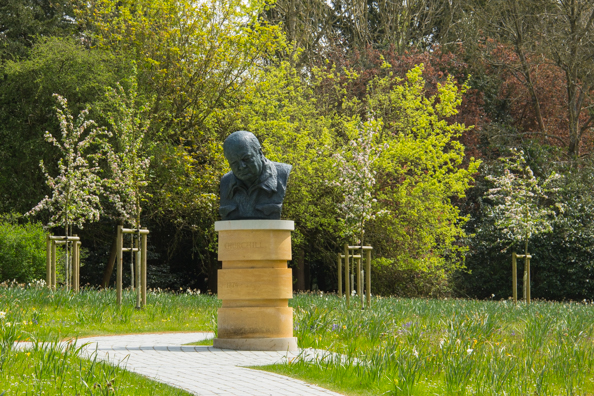
Now I had a decision to make – walk round the formal gardens or take the miniature train to pleasure gardens? I chose the former and joined a tour that took us through the main courtyard and onto the water terraces behind the house. A path out of these gardens led us into the Winston Churchill Memorial Garden. This was established behnd the Temple of Diana where Churchill proposed to his wife, Clementine, while sheltering from a shower of rain. According to Alistair, our guide, Clementine had to steer that particular conversation in the right direction. Winston Churchill was born at Blenheim Palace but was never destined to succeed to the title of Duke of Marlborough. Paving stones on the walk through the garden describe significant dates in the life and career of this great statesman.
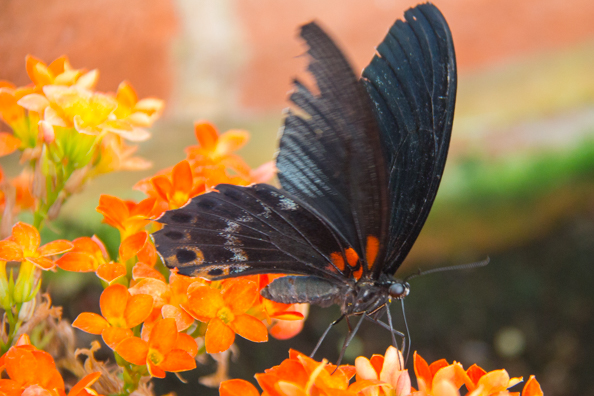
There was still time to jump on the miniature train that took me to the Pleasure Gardens. It was too early in the year for the lavender garden to be in bloom but the Butterfly House was a riot of stunning exotic blooms with butterflies flitting among them and a family of Zebra birds pottering around the plants.
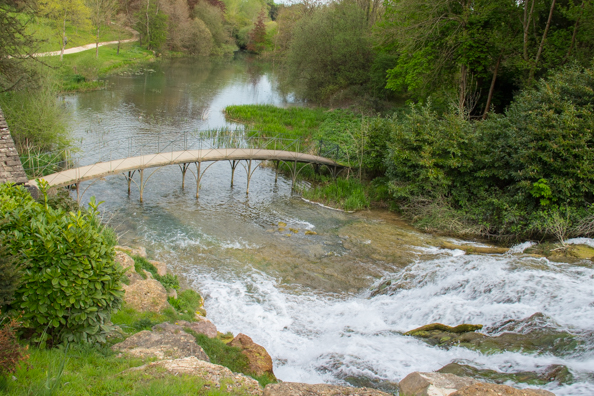
Visitors of all ages enjoy the miniature train and at the end of the line parents can relax in the gardens while the children let off steam in the adventure playground or get lost in the maze. This maze is one of the world’s largest hedge maze. I wished I had time to take on the challenge but if I got the next train back to the Palace Station there would just be enough time to explore the Secret Garden and maybe take the path to the end of the lake to see the Cascades. The flower beds in the Secret Garden were as well kept as its secret and I would have loved to have sat for a while to enjoy its tranquillity. But I really wanted to see the Cascades, one of Capability Brown’s triumphs. As it was late afternoon there were very few visitors on the lakeside path so I could keep up a brisk pace and I was soon at the Cascades. It was worth the effort but now it was becoming a race against time to get back to the palace before closing time. It had been a very full and enjoyable day.
Kew Gardens
Kew Gardens can be divided into two distinct areas – formal gardens and parkland. On entering through the Victoria Gate a beautiful pond protected by two Chinese guard lions immediately catches the eye. Beyond the water is the Palm House.

A circuit of the gardens on the Kew Explorer, a hop-on and hop-off service, is a good way to start the day and decide which attractions to return to later. The Palm House, a huge Victorian greenhouse (based on the design of a ship) is one of forty-four Grade 1 listed buildings in the Gardens. It became the model for greenhouses of that era worldwide and is now the most important surviving structure of its kind. It is certainly worth a visit.
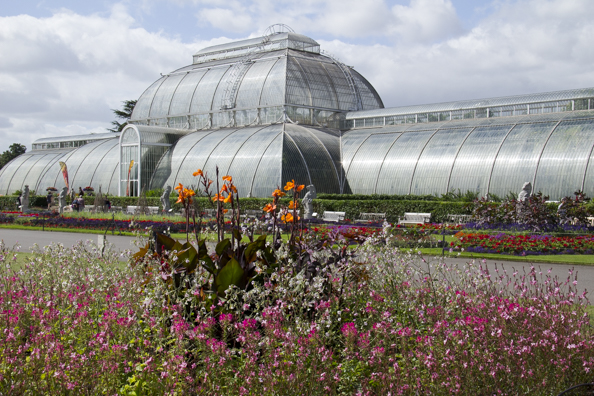
Outside the Palm House a line of heraldic figures, the ‘Queen’s Beasts’, replicate the sculptures that stood at the entrance of Westminster Abbey during the coronation of Queen Elizabeth II in 1953. They illustrate the close association between the Royal family and the gardens and palace at Kew.

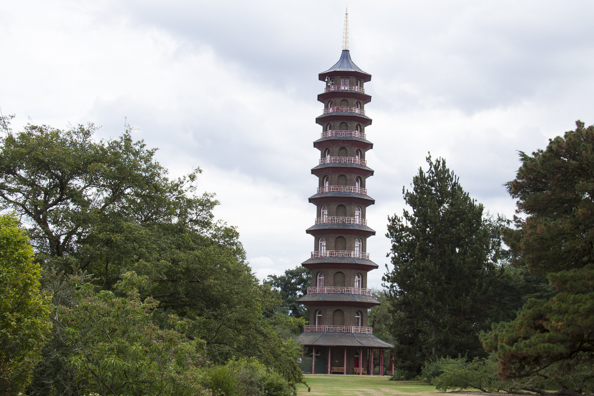
After acquiring Kew Palace in 1729 the British Royal Family developed the surrounding gardens creating a national treasure which, was designated a UNESCO world heritage site in 2003. Features in the historic landscapes of the gardens reflect the changing periods of this art through the eighteenth, nineteenth and twentieth centuries. The gardens are particularly famous for their follies, defined in the Oxford English dictionary as a costly ornamental building with no practical purpose. During the eighteenth century Frederick, Prince of Wales and subsequently his wife Princess Augusta worked with architects Sir William Chambers and the Earl of Bute to create a series of garden follies in Kew Gardens. These structures, made of flimsy materials, are a legend of Kew Gardens. They were not built to last but some of them still grace the Gardens. The Temple of Aeolus a small temple on a mound not far from the entrance is a good example of one of them. But the most famous of these follies is the fifty-metre high, ten-storey Chinese-style pagoda. The Pagoda was designed and built by William Chambers in 1762 when Chinoiserie was fashionable and it quickly became an icon of the gardens and remains so to this day although it has undergone several restorations and none as colourful as the original.
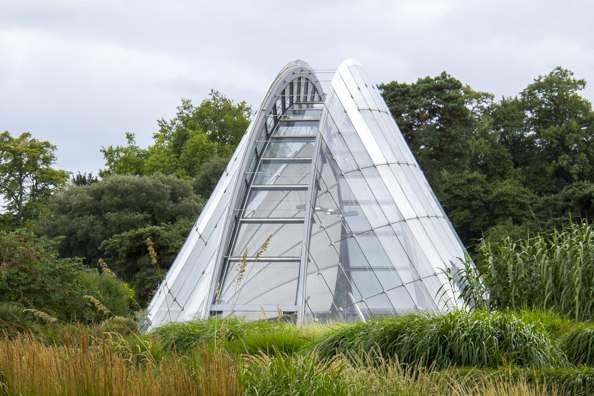
The gardens are still developing with the recent addition of some interesting buildings. These include the Princess of Wales Conservatory which features ten climatic zones and the plants associated with them. My favourite is the orchid house. But I was also fascinated by the sea thistles in the Davies Alpine House. This half-dome glass structure employs a mixture of traditional practices and the latest technology to create the cool, dry and windy conditions favoured by alpine plants all year round.
The parkland area boasts a tree top walkway. One attraction at Kew Gardens that is definitely not a folly. Walking amongst the tree tops is a fascinating experience and there are wonderful views of the surrounding area. In particular, it is a good opportunity to appreciate the splendid Temperate House which is currently under restoration.

Other features include the Japanese landscape which was designed to complement the Japanese Gateway or Chokushi-Mon (Gateway of the Imperial Messenger). This gate was originally created for the Japan-British exhibition in 1910 after which it was reconstructed in the Gardens. And the interesting bridge, the first to cross the lake, and known as the Sackler Crossing after Theresa Sackler, whose donation made it possible. This crossing, designed by the architect John Pawson is part of a new route to give access to the more isolated sections of the Gardens.

Around 1754 a small cottage single-storey cottage was built in the grounds of Richmond Lodge (now the western half of Kew Gardens). It was given to Queen Charlotte by her king and it became her private haven. The cottage grounds include a wonderful bluebell wood. When Queen Victoria ceded the cottage to Kew it was on the condition that the surrounding woodland should be kept in it is natural state. These grounds now form part of the Kew Gardens Conservation Area. Here I found the Stag Beetle Loggery created as a safe haven for the endangered stag beetle. And I had the pleasure of watching children and their parents exploring the log trail and having a picnic at the Alice in Wonderland table nearby.

Visitors to the gardens stumble on one delight after another as they stroll around the gardens and through the park – too numerous to mention. The gardens also host a variety of events and exhibitions throughout the year. One day is not enough to do these wonderful gardens justice.
Marwell Zoo
Where to start? Maxwell Zoo near Winchester, is much larger than I had anticipated. Once inside I immediately spotted the penguin pool on one side of the road and then I saw a flock of flamingos on the other. Flamingos first, then penguins. Then I spotted the sign to the giraffe house and remembered that there was to be a talk about giraffes in a few minutes so I made my way up there. As I arrived the giraffes emerged from their high-roofed house. Obviously anxious to hear about themselves. As I wondered what to do next the free road train appeared so I decided to go to the far end of the park and make my back on foot. I could have taken the rail train whose track goes inside some of the enclosures but that was already full of excited children.

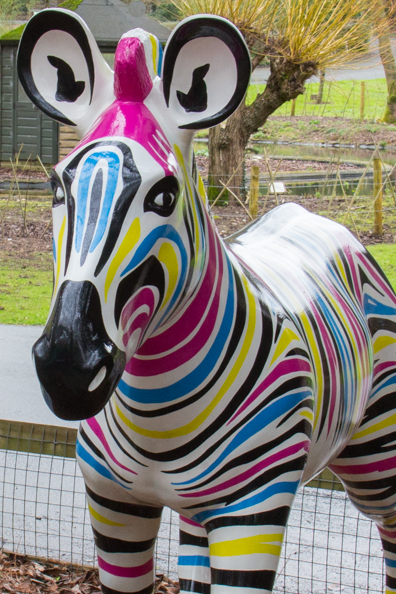
As I set off to walk back aided by well-placed maps, information boards and signposts I passed several enclosures inhabited by herds of different ungulates. I was not surprised to read that Marwell houses the largest collection of ungulates in Europe. When John Knowles founded the zoo in 1972 it was with a view to the conservation of endangered species and in particular ungulates. The scimitar-horned oryx was one of the first species to be kept at Marwell and more than 200 calves have been born and reared there. Marwell was one of the first European zoos to focus on animal conservation. It is now an important breeding centre for several endangered species. Currently Marwell is focusing on the zebra and I had met Gilbert, the Zany Zebra when I arrived. Gilbert and his zany friends will be on a public art trail around Southampton this summer raising fund for the zoo.
I was trying to spot the difference between the Hartmann’s mountain zebra and Grevy’s zebra when I heard a commotion from the amur leopard enclosure. A leopard was on the prowl! I hurried over that and was able to get some good images thanks to the well-placed Perspex panels amongst the secure wire fencing.

It was a pedestrian safari – watching to see where the crowds were gathering. The animals are not pestered to show themselves so it is a matter of luck regarding sightings of some animals that made it more exciting. As I meandered too and fro I did make a point of visiting the Marwell Hall which John Knowles had bought when he was desperate for somewhere to house his growing collection of animals. This lovely old building was once the residence of Sir Henry Seymour, the brother of Jane Seymour, Henry VIII’s third wife. The hall is now owned by the Marwell Zimbabwe Trust which was established in 1997 as a non-profit making wildlife conservation and research organisation. It is available to hire for events and conferences. It is also a venue for ghost hunts and its most famous ghost an unfortunate bride who, on the eve of her wedding, was locked in a trunk while playing hide-and-seek with her guests.

There was so much to see that I did not want to stop for lunch so I was pleased to find a snack stop with tables and benches where I could have a quick bite to eat and a hot drink. I was captivated by the oriental or Asian small-clawed otters frolicking on the river bank.

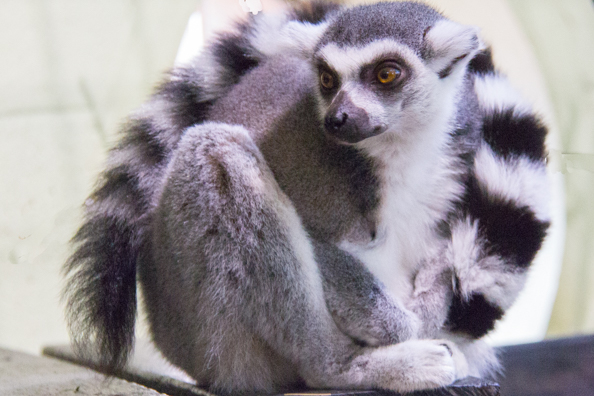
I spent a long time in the World of Lemur, a fascinating and well-laid out complex of linked cages and enclosures. Visitors can watch the lemurs playing in their separate gardens from the viewing areas furnished with benches.
And I was amused by the antics of the meerkats as they burrowed in the sand and climbed trees, all the time taking up their famous look-out stance. One of these groups was positioned close to some yellow mongooses and it appeared there was some name calling going on between the two groups.
All too soon it was time to leave but as I was making my way to the exit I spotted three white rhinos in the distance outside the Wild Explorers building and raced back up the the hill. It was a real treat watching two adults and a baby gambolling in their paddock.

It really was time to be making my way out of the park but I could not resist a last look at the amur tiger. A magnificent animal and one that future generations may not get to see without the work of places like Marwell Zoo. The perfect combination of education, entertainment and excitement.
A career break from the legal profession resulted in a career change and since then I have been travelling the world as a tour leader. I started writing about my experiences in 2008 and I have my own blog as well as writing regularly for other websites. I love blogging as it is instant and a great way to showcase my photography – another passion of mine. I write honest accounts of my experiences in the hope they will inspire other travellers. You can read my online travel journal at https://experiencedtraveller.com